Share This Article
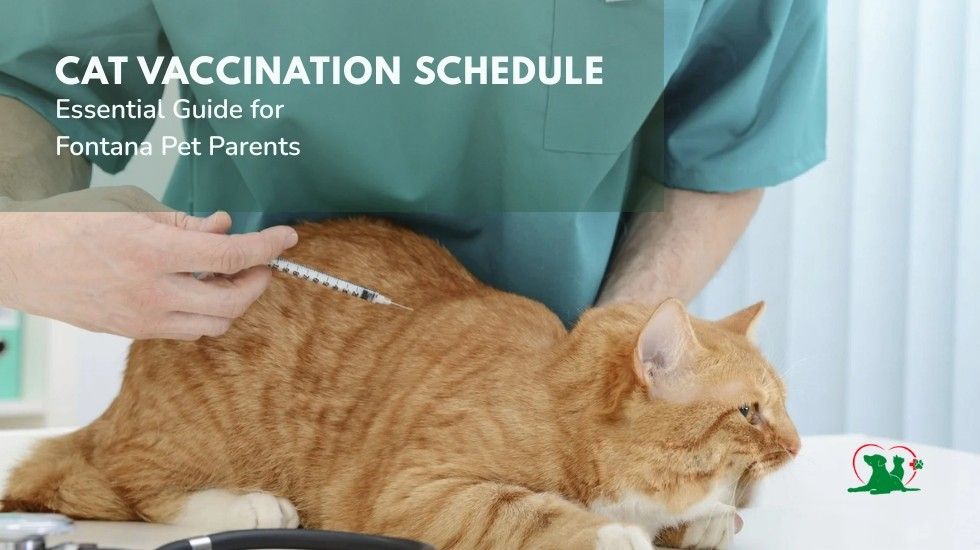
A cat vaccination schedule begins when kittens are 6–8 weeks old. Booster vaccinations continue every 3–4 weeks until about 16 weeks to build long-term immunity. Adult cats need regular boosters based on age, lifestyle, health, and your veterinarian's recommendations.
- Key takeaway:
- Why Is Vaccination Important for Cats?
- Core vs Non-Core Cat Vaccine: What’s the Difference?
- What Is the Recommended Kitten Vaccination Schedule?
- How Does the Cat Vaccine Timing Fontana Change for First-Time Adults?
- What Vaccine Side Effects in Kittens / Cats Are Expected and When Should You Call the Vet?
- What to Expect at Your Visit to Local Vaccine Clinics Fontana?
- Prioritize Your Cat’s Immunity – Schedule a Wellness Visit Today!
Key takeaway:
- Vaccinations protect cats from serious, contagious diseases and help reduce the spread to other animals and people, with rabies vaccines often required by law.
- Core vaccines are recommended for all cats, while non-core vaccines are chosen based on lifestyle, environment, and exposure risk.
- Kittens need a series of vaccines starting at 6 to 8 weeks, followed by boosters to build lasting immunity as maternal protection fades.
- Adult cats with unknown vaccine history usually need a primary series before moving to routine booster schedules.
- Mild vaccine reactions are common and temporary, but severe symptoms require immediate veterinary care.
When was the last time you felt sure about your cat’s health choices? If not, that’s okay. This guide will walk you through the essentials so you can feel confident again. Here, you’ll explore core and non‑core vaccines, a clear cat vaccines schedule Fontana, adult booster recommendations, and when titer testing is useful.
You’ll also learn to recognize common post‑vaccine reactions, identify warning signs, understand what to expect at visits, and get practical tips to plan care with confidence, starting with their very first appointment for cat vaccination services.
Why Is Vaccination Important for Cats?
Pet vaccination is one of the simplest ways to keep your cat healthy by preventing serious diseases before they start. It’s an essential part of responsible pet care services. Understanding the importance of pet vaccines helps you take proactive steps to protect your pet from preventable illnesses. Below are the key reasons it matters a lot:
- A vaccine protects your cat before they catch a disease. It trains their immune system to respond faster, so the illness is either milder or avoided. Following a consistent cat / kitten vaccination schedule Fontana can help ensure this.
- They protect other animals and people. Vaccination lowers spread in multi-cat homes and shelters, and rabies shots protect humans. Rabies vaccination is often required by law.
- Saves money and suffering. Preventing a disease is usually much cheaper and kinder than treating it.
Core vs Non-Core Cat Vaccine: What’s the Difference?
Choosing vaccines for your cat comes down to two things: the risk of common, serious diseases and your cat’s individual lifestyle. Understanding these factors can also help you better estimate the cat vaccine cost for your pet’s routine care. The table below explains the differences between core and non-core vaccines that cats usually get in their lifetime:
| Aspect | Core vaccines | Non-core vaccines |
| What they are | Recommended for all cats because they protect against common, serious, or widely circulating diseases | Given only when a cat’s lifestyle, environment, or health makes them necessary |
| Who should get them | All cats, regardless of age or lifestyle | Cats at specific risk: outdoor cats, cats in multi-cat homes or shelters, boarding cats, or cats in high-prevalence areas |
| Main goal | Prevent widespread, serious disease and protect public health (rabies) | Reduce risk of specific infections tied to behavior, environment, or local outbreaks |
| When to delay or change the plan | May delay if your pet is ill or pregnant; the vet will tailor the cat vaccination schedule | More likely to withhold if health or age makes the vaccine risky; chosen only when benefits outweigh risks |
| Legal / boarding requirements | Rabies is often required by law; many boarding facilities have core vaccine requirements for boarding | Boarding or shelters may also require certain non-core vaccines (for example, Bordetella) |
| Common examples | Feline panleukopenia (FPV, aka feline distemper), feline herpesvirus (rhinotracheitis, FHV‑1), feline calicivirus (FCV), rabies | Feline leukemia virus (FeLV), feline immunodeficiency virus (FIV), feline infectious peritonitis (FIP), Chlamydia felis, Bordetella |
What Is the Recommended Kitten Vaccination Schedule?
Knowing when to vaccinate a kitten gives them the best start. Vaccines are given in a series because early doses start the immune response and later doses boost protection as maternal antibodies wear off. As part of our helpful pet vaccine guide, the plan below shows a common kitten vaccination schedule many clinics follow:
| Age | Vaccines commonly given | Notes for cat parents |
| 6 to 8 weeks | FVRCP (Feline viral rhinotracheitis [FHV‑1], Calicivirus, Panleukopenia)—1st dose | Start core protection. If your vet recommends FeLV for your kitten, the FVRCP vaccine schedule and associated FeLV timing can also begin at 8 weeks. |
| 9 to 11 weeks | FVRCP—2nd dose | Repeat every 3 to 4 weeks until the kitten is at least 16 weeks old. |
| 12 to 16 weeks | FVRCP—final kitten dose; Rabies—initial (where allowed at this age); FeLV—2nd dose if series started | Finish the FVRCP series at 16 weeks or older for best protection. Ask your vet about the rabies vaccine for cats timing, since rabies timing depends on the product and local law.
Many areas allow or require a dose at 12 to 16 weeks. FeLV is given to kittens at risk (outdoor access, multi-cat household with unknown status, shelter exposure). |
| 16 weeks (if needed) | Any remaining series doses (FVRCP or FeLV) | Ensure all initial series doses are completed by 16 weeks or as your vet directs.
If FeLV was started, follow the recommended FeLV vaccine schedule to complete protection. |
| 1 year from completion of kitten series (about 12 months after final kitten FVRCP dose) | FVRCP booster, Rabies booster, FeLV booster (if kitten received FeLV series and remains at risk) | This visit is often called the 1-year booster and confirms long-term protection. It completes the kitten booster schedule.
After this, many core vaccines move to a 1- to 3-year feline vaccine schedule depending on vaccine and local rules. |
How Does the Cat Vaccine Timing Fontana Change for First-Time Adults?
If your adult cat has no reliable vaccine records (in case you’ve adopted them from a shelter or rescued them from somewhere), vets usually treat the cat as unvaccinated and start following a primary series of core cat vaccines schedule.
The approach below follows the local cat vaccination schedule Fontana used by area clinics to ensure consistent protection:
What vets commonly give and when:
- FVRCP (feline viral rhinotracheitis, calicivirus, panleukopenia): Most adult cats with unknown history receive two doses spaced 3 to 4 weeks apart. This creates a reliable primary immune response.
- Rabies: The initial rabies vaccine is usually a single dose given on first presentation. Follow-up boosters depend on the vaccine label and local law, generally a one-year booster, then either yearly or every three years. Discuss annual vs triennial boosters with your vet so you know which schedule applies to your cat.
- FeLV (feline leukemia): AAHA treats FeLV as core for kittens and young cats but risk-based for adults. For an adult at risk, vets usually give two doses 3 to 4 weeks apart, but many clinics test for FeLV antigen before vaccinating.
- Timing after the initial series: Your vet will usually recommend a booster approximately one year after the completed initial series. After that, some core vaccines are given every three years while others follow different intervals based on the product and your cat’s exposure risk.
When a single dose may be used:
Some modified-live or recombinant vaccines can produce solid immunity with a single dose in adult animals, but this depends on the product and the cat’s risk. Because product labels and evidence vary, most clinicians still give two doses for a full primary series unless the label or a clear reason supports a one-dose approach.
Titer testing: What it can and can’t do:
- Titers measure antibody levels and can sometimes tell whether a cat is protected. They’re most useful for panleukopenia (FPV), where antibody presence correlates well with immunity. Consider vaccine titer testing cats when you want to avoid unnecessary boosters but still confirm protection.
- Titers are less reliable for FHV-1 and FCV because protection depends on cell-mediated as well as antibody responses. Rabies serology isn’t accepted in many places as a substitute for vaccination.
- Discuss with your vet whether titers are a sensible alternative to automatic boosters for your cat and how that fits your overall cat vaccination schedule.
What Vaccine Side Effects in Kittens / Cats Are Expected and When Should You Call the Vet?
Vaccines are an important aspect of ensuring your cats stay well, but they can cause mild reactions in the hours or days afterwards. Most of these signs are temporary and easy to manage at home.
What’s common and how long it lasts:
- Mild signs are normal and usually short-lived. These include soreness or a small lump where the shot was given, sleepiness, decreased appetite, mild fever, or mild sneezing after an intranasal vaccine.
- Most mild reactions start within hours of the shot and get better in 24 to 72 hours. You can offer food and water, keep your cat warm and quiet, and let them rest.
Watch for immediate reactions:
Some allergic reactions happen right away, which is why clinics often ask owners to wait 10 to 30 minutes after vaccination. Signs to watch for immediately are facial swelling, hives, severe difficulty breathing, pale gums, collapse, or sudden vomiting and diarrhea.
When to call your vet right away:
Call immediately if your cat has trouble breathing, a very swollen face or throat, repeated vomiting, severe diarrhea, collapse, seizures, or fainting. These may be signs of a severe allergic reaction and need urgent care.
When to call your vet the same day:
Call if mild signs are getting worse instead of better, your cat refuses all food and water for more than 24 hours, the injection site becomes hot, very painful, or increasingly swollen, or your cat seems unusually lethargic or disoriented.
What to Expect at Your Visit to Local Vaccine Clinics Fontana?
When you’re preparing your pet for a vet visit to a clinic, like Jurupa Hills Animal Hospital, the appointment is usually quick and focused on making sure the shot is safe and useful. Here’s what generally happens at the visit:
- Quick wellness exam: Temperature, heart and lungs, coat and mouth, and a check for signs of illness. Vaccination may be delayed if your cat is sick or pregnant.
- How vaccines are given: Most are under the skin, some are intranasal. Intranasal vaccines can cause brief sneezing; injections may cause mild soreness.
- Short observation and paperwork: You may be asked to wait 10 to 30 minutes for monitoring. The clinic will provide a vaccine card showing vaccine name, date, manufacturer, lot number, injection site, and next booster date.
- Follow up: Staff will schedule any needed boosters and may set reminders by text or email. Kittens often need doses 3 to 4 weeks apart; adults usually follow a two-dose primary series if history is unknown. Local clinics often align your cat’s record to the standard cat vaccines schedule Fontana.
Prioritize Your Cat’s Immunity – Schedule a Wellness Visit Today!
Vaccinations protect cats from serious disease, with core shots recommended for all and non-core vaccines chosen based on lifestyle and risk. Follow the kitten and adult cat vaccines schedule Fontana, consider titer testing where appropriate, and monitor for common, short-lived post-vaccine reactions.
If you’re looking for personalized guidance or need to book a visit, contact us online, schedule an appointment, or call (+1) 909‑333‑1565 at Jurupa Hills Animal Hospital.
Frequently Asked Questions
Share This Article

Written by : Jurupa Hills Animal Hospital
Jurupa Hills Animal Hospital is proud to serve the Fontana, CA area for everything pet-related. Our veterinary clinic and animal hospital is run by Dr. Avtar Gill, who is a licensed, experienced Fontana veterinarian. Our team is committed to educating our clients on how to keep your pets healthy year round, with good nutrition and exercise. Jurupa Hills Animal Hospital stays on top of the latest advances in veterinary technology and above all, remembers that all animals and pets need to be treated with loving care in every check-up, procedure, or surgery.
All Categories
- Pet Allergies
- Pet Dental
- Pet Euthanasia
- Pet Microchipping
- Pet Parasite
- Pet Routine Checkup
- Pet Surgery
- Pet Vaccination
- Spaying and Neutering
Related Articles

October 6, 2026
October 6, 2026